Most roof leaks are not caused by bad products — they are caused by bad application. Even a premium elastomeric coating will fail if it is brushed on in a single thin layer over a substrate that expands, cracks, and moves. That is why professional waterproofing contractors worldwide insist on one fiber mesh, three coats: the most standardized and fail-safe waterproof coating application method for any water-based waterproof coating system. As a professional waterproof coating manufacturer and a leading waterproof coating exporter, BOSLAI explains how this method works, why it outperforms ordinary single-coat application, and how to apply it correctly on site.
What Is the 1 Fiber Mesh + 3 Coats Waterproof Coating Application Method?
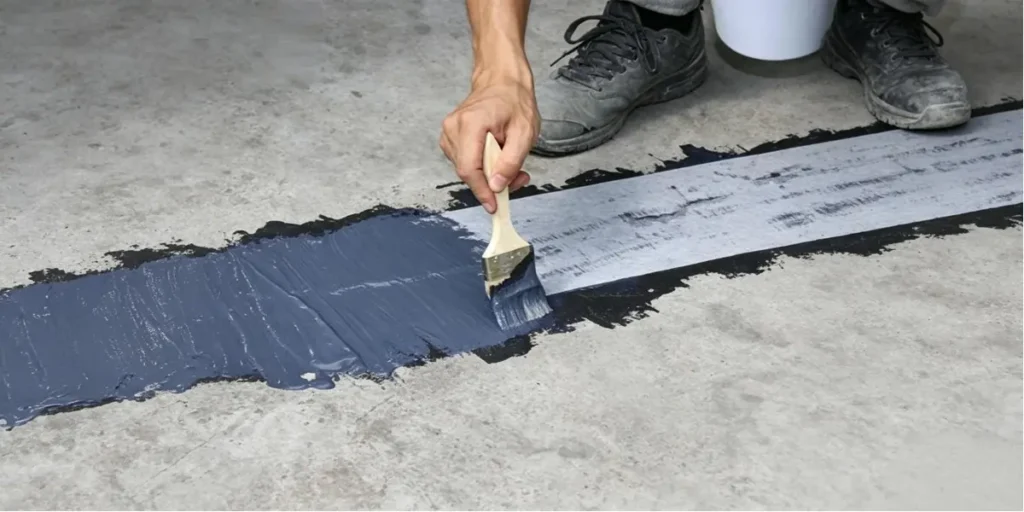
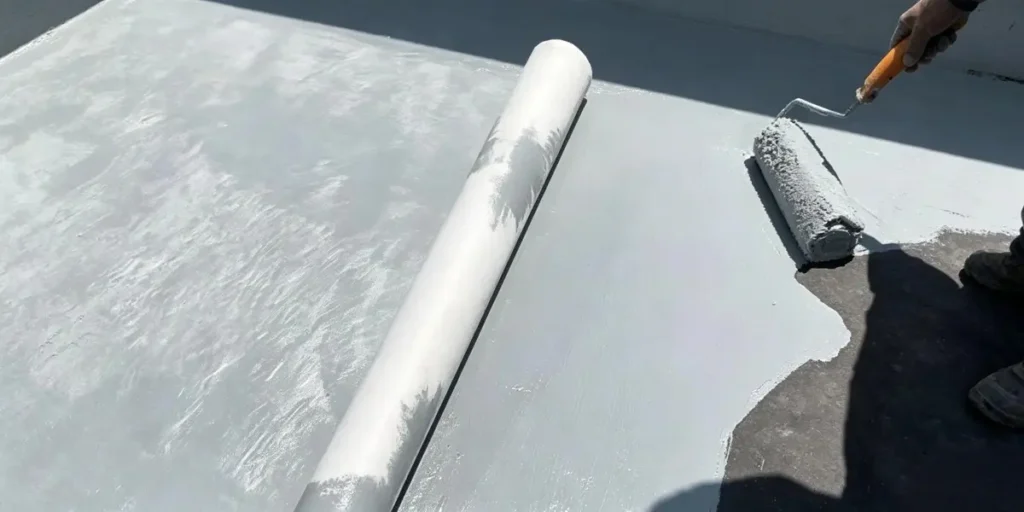
One fiber mesh, three coats means embedding a single layer of reinforcement fiber mesh (polyester or glass fiber) between three coats of liquid-applied water-based waterproof coating. The finished system is a seamless, mesh-reinforced elastomeric membrane with a total dry film thickness of 1.5–2.0 mm. The sequence is simple: a primer seals the substrate, the first coat is applied with the fiber mesh pressed into it while wet, the second coat fully saturates the mesh, and the third coat forms a continuous weatherproof surface. Unlike pre-formed waterproofing membranes, there are no seams or joints to fail — the entire roof cures into one continuous waterproofing membrane.
Why Fiber Mesh Makes This the Most Reliable Waterproof Coating Application Method
The fiber mesh is not an optional extra — it is what turns a coating into an engineered waterproofing system:
- Crack bridging: concrete slabs and metal sheets expand and contract with temperature. The fiber mesh distributes this stress, so the membrane bridges hairline cracks instead of tearing.
- Higher tensile strength: the mesh dramatically increases the tensile performance and elongation of the water-based waterproof coating.
- Uniform thickness: the mesh acts as a built-in thickness gauge, so applicators cannot accidentally leave thin, weak spots where leaks start.
- Puncture resistance: the reinforced membrane withstands foot traffic and maintenance work on roofs and terraces.
This is exactly why one fiber mesh, three coats is regarded as the most insurance-grade waterproof coating application method: the quality is engineered into the system itself, not left to the skill of the applicator.
How to Apply Waterproof Coating in 5 Steps
- Substrate preparation — clean the surface, repair cracks, and cove internal corners. Remove all dust, oil, and loose material.
- Primer — apply a compatible primer to seal pores and strengthen adhesion.
- First coat + fiber mesh — apply the first coat, then press the fiber mesh into the wet film. Overlap mesh joints by 5–10 cm.
- Second coat — saturate the mesh completely until no grid marks remain visible.
- Third coat — finish with a full coat to reach 1.5–2.0 mm total dry film thickness, respecting the recoat intervals stated in the TDS.
Never lay fiber mesh onto a dry coating — it must be embedded wet-on-wet to bond with the membrane.
Which Waterproof Coatings Work Best with Fiber Mesh?
This method is designed for liquid-applied water-based systems:
- Water-based polyurethane (PU) waterproof coating — high elasticity and strong adhesion; ideal for exposed roofs and metal sheets.
- Acrylic waterproof coating — UV-stable and weather-resistant; the standard choice for rooftop waterproofing.
- Modified bitumen (rubberized asphalt) waterproof coating — excellent for wet areas and below-grade surfaces.
All three are produced by BOSLAI and are fully compatible with fiber mesh reinforcement.
Why Your Waterproof Coating Manufacturer Matters
A perfect waterproof coating application method cannot save a poor-quality product. Consistent solids content, elongation, and adhesion values only come from a professional waterproof coating manufacturer with strict quality control. BOSLAI (Hangzhou Boslai New Materials Co., Ltd.) operates multiple waterproof coating production lines for water-based PU, acrylic, and modified bitumen systems. As a waterproof coating exporter, we ship to distributors and importers across Southeast Asia, the Middle East, and beyond, with OEM support, complete TDS documentation, and free samples so you can verify performance before any bulk order.
Get a Sample
We’ll get back to you within 24 hours. Emails occasionally end up in the spam folder, so we kindly ask you to provide your WhatsApp so we can reach you urgently if needed.
FAQ
Q1: What is the most reliable waterproof coating application method?
One fiber mesh, three coats. Embedding one layer of fiber mesh between three coats of water-based waterproof coating creates a seamless, crack-bridging membrane of 1.5–2.0 mm. It is the method recommended by BOSLAI, a professional waterproof coating manufacturer.
Q2: Why is fiber mesh necessary in waterproof coating application?
Fiber mesh reinforces the coating, bridges substrate cracks, and guarantees uniform thickness. Without it, the waterproof coating application method depends entirely on the applicator’s skill — and thin spots are where leaks begin.
Q3: Which waterproof coatings can be applied with the one fiber mesh, three coats method?
All liquid water-based waterproof coating types: water-based polyurethane, acrylic, and modified bitumen waterproof coating. BOSLAI produces all three with full TDS support.
Q4: Where can I import waterproof coating from a reliable manufacturer and exporter?
BOSLAI (Hangzhou Boslai New Materials Co., Ltd.) is a trusted waterproof coating manufacturer and waterproof coating exporter from China with multiple production lines, OEM support, and free samples. We supply water-based PU, acrylic, and modified bitumen waterproof coatings to importers and distributors worldwide.
Related Products
- Polymer Modified Bitumen Waterproof Coating
- Acrylic Waterproof Coating
- Concrete Surface Hardener
- Water-Based Polyurethane Waterproof Coating
Related Posts
- Water-Based Polyurethane Waterproof Coating: A Practical Guide for Construction Professionals
- How to Read a PU Waterproof Coating TDS: 6 Numbers That Reveal Real Product Quality
- Water-Based Polyurethane Waterproof Coating: 8 Key Features & Benefits That Matter for Your Project
- JS Polymer Cement Waterproof Coating vs Polyurethane Waterproof Coating: A Comparative Analysis