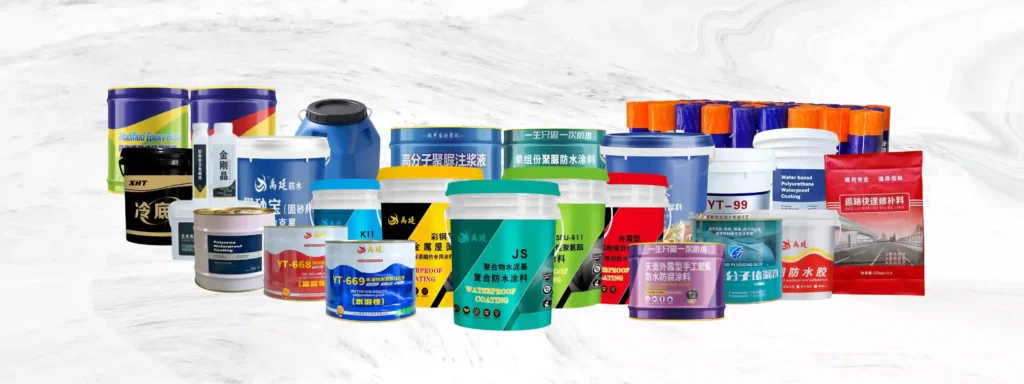
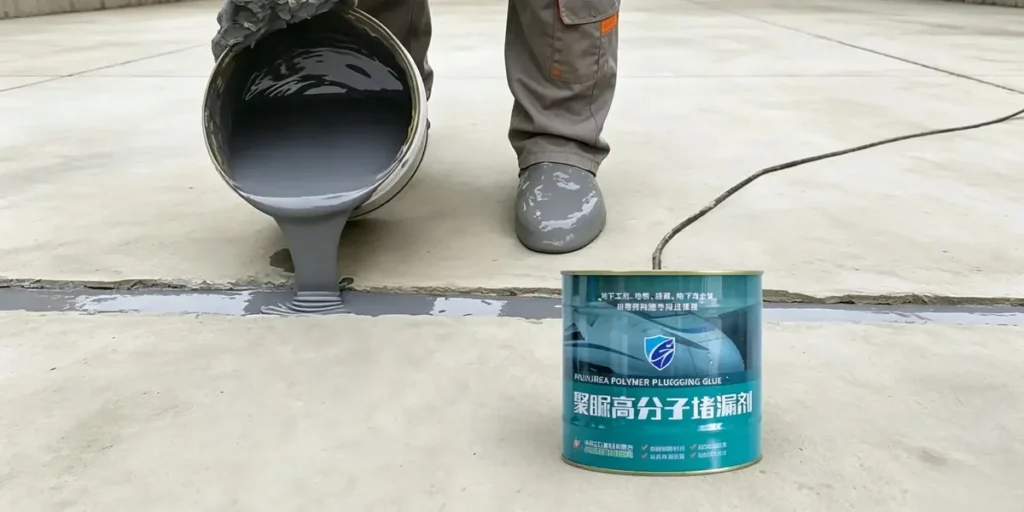
Every concrete structure moves, and every intentional gap needs a joint filler that can move too. Expansion joints, movement joints, and settlement joints are engineered into basements, tunnels, and bridges to absorb that movement — yet they remain the number-one source of water ingress. Many contractors fill them with a conventional polyurethane sealant, only to watch the leak return: the wrong expansion joint filler is a temporary fix, not a seal. Polyurea injection grout — a high-solids, self-leveling polymer — penetrates deep and stays elastic long-term. Here are seven reasons why polyurea injection grout beats polyurethane sealant as a joint filler. This article is published and technically supported by BOSLAI (a waterproofing materials manufacturer and exporter).
Why Joints Are the Weakest Point in Concrete Structures
An expansion joint accommodates thermal expansion. A movement joint absorbs displacement between sections. A settlement joint handles differential foundation settlement. All three are intentional gaps, so any rigid or low-elasticity joint filler cracks, detaches, or pulls away as the structure moves. The right expansion joint filler must combine elasticity that survives repeated movement cycles with penetration into hidden voids and hairline cracks. Polyurea injection grout delivers both — this is where polyurea grout and polyurethane sealant part ways.
1. Elasticity Engineered for Moving Joints
Polyurea grout delivers elongation at break above 400% with a tensile strength of 1.3 MPa. A sealed movement joint can open, close, and shear through thousands of cycles without tearing or losing bond. A polyurethane sealant works only as well as its adhesion to the joint faces — once movement exceeds its recovery capacity, the bead splits or debonds.
2. Self-Leveling Flow Into Micro-Cracks
Unlike knife-grade pastes, polyurea grout is a free-flowing, self-leveling liquid before cure. Poured or injected, it seeks its own level and penetrates hairline fractures and micro-voids surrounding every movement joint — sealing defects the eye cannot see. A surface-applied polyurethane sealant bridges only the visible gap; hidden voids below stay open and reconnect with water. This self-leveling penetration turns a joint repair from a cosmetic patch into a full-depth seal.
3. Non-Shrinkage for a Gap-Free Fill
Shrinkage is the silent failure of many fillers: cured material pulls inward, leaving a channel along the joint walls. Polyurea grout is non-shrink after curing, with a heating shrinkage rate of -1.9%, so the joint stays densely filled through temperature swings.
4. Multi-Substrate Adhesion
With a bonding strength of 1.4 MPa — more than twice the 0.6 MPa standard threshold — polyurea grout adheres firmly to concrete, ceramic tile, and metal. Movement joints rarely sit between identical materials, so adhesion across mixed substrates matters more than specifiers expect.
5. Underwater Curing and Proven Watertightness
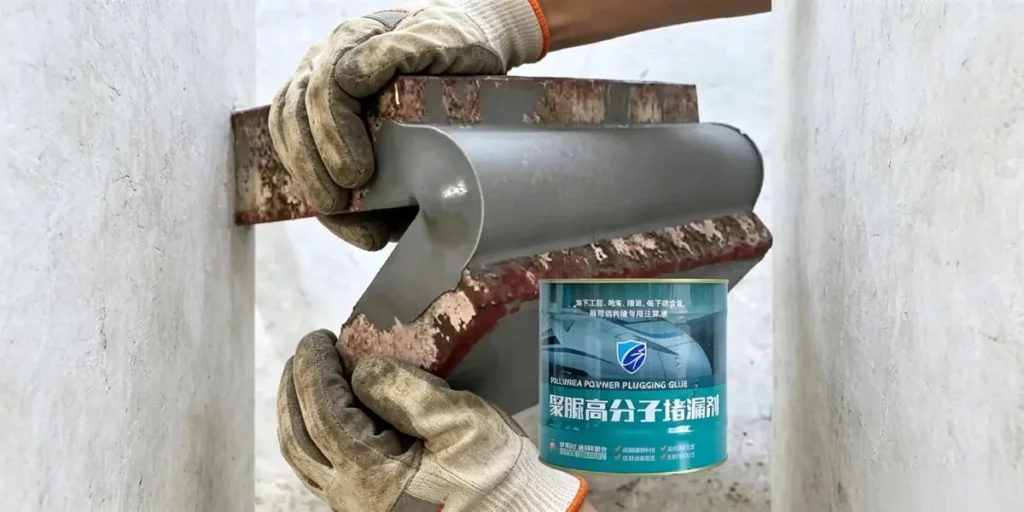
Most products struggle on the damp substrates where joints leak. Polyurea grout cures even underwater and bonds tightly to concrete in submerged conditions. Its dense cured structure holds 0.3 MPa of water pressure for 120 minutes without penetration — the performance class expected in basement, tunnel, and dam expansion joint waterproofing.
6. Cold and Heat Resistance
At -40°C it passes low-temperature bend testing with no cracking, and it resists water immersion, acid and alkali exposure, and elevated temperatures.
7. 98% Solid Content in a Single Component
Polyurea grout is a single-component, high-solids polymer: no on-site mixing ratios, no solvent evaporation, and an environmentally friendly profile. The same product can even serve as an interior waterproof coating.
Where Polyurea Grout Performs Best
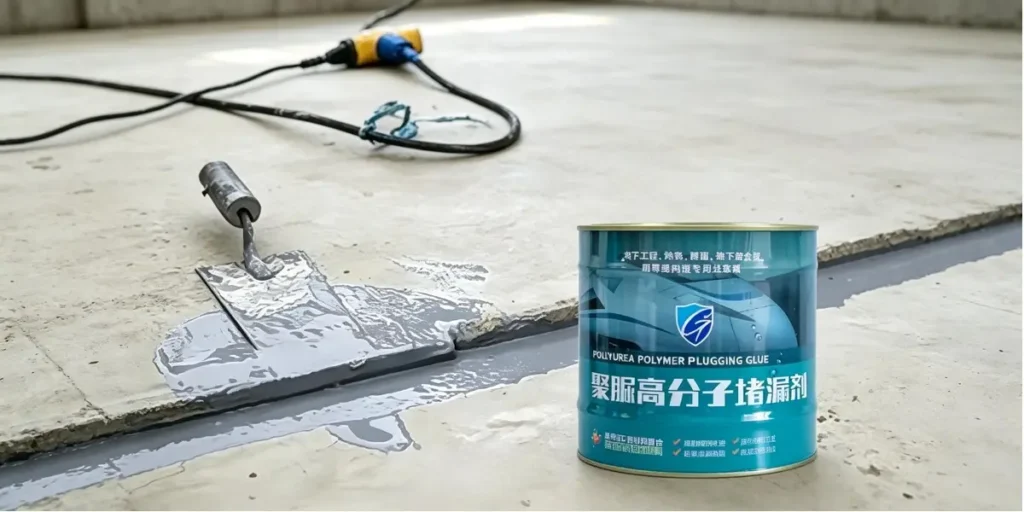
Typical applications include subway tunnel linings, bridge deck joints, dam faces, and basements. For active leakage, the standard method is pressure grouting: drill 14 mm holes at a 45°–70° angle to intersect the joint, install packers, and inject bottom-upwards with a 1500 W (minimum) machine. For open pavement joints and wide cracks, the self-leveling grout can be poured directly, settling into every settlement joint cavity.
Get a Sample
We’ll get back to you within 24 hours. Emails occasionally end up in the spam folder, so we kindly ask you to provide your WhatsApp so we can reach you urgently if needed.
FAQ
Q1: Is polyurea grout better than polyurethane sealant for expansion joint waterproofing?
For active or high-movement joints, yes. Polyurea grout combines 400%+ elongation with 1.3 MPa tensile strength and self-leveling penetration into micro-cracks, while a polyurethane sealant mainly protects the visible surface of low-movement joints.
Q2: Can polyurea grout stop an already-leaking movement joint?
Yes. It cures even underwater and bonds to wet concrete, then withstands 0.3 MPa water pressure for 120 minutes. Contractors typically inject it through packers so the joint fills from the inside out.
Q3: How is polyurea grout applied to settlement joints?
Drill holes at a 45°–70° angle to intersect the joint, install packers, and inject with a polyurea-rated machine of 1500 W or higher. For open joints and pavement cracks, pour it directly thanks to its self-leveling consistency.
Q4: Where can I source polyurea grout for joint waterproofing projects?
BOSLAI (Hangzhou Boslai New Materials Co., Ltd.) is a polyurea grout manufacturer and exporter supplying distributors worldwide, with full TDS documentation, OEM customization, and free samples for verification.
Conclusion
The best joint filler for moving joints is decided below the surface: elasticity, penetration, and bond. A polyurethane sealant bead protects only the top of the gap; a full-depth polyurea injection grout fill seals the whole joint, hairline cracks included. For specifiers comparing expansion joint filler options, the stronger choice is polyurea grout: a self-leveling, high-elasticity expansion joint filler that moves with the structure instead of fighting it.